
Loonity is built like a social network, it is designed to be the common ground where many different local distribution networks flourish and grow. Loonity wants to create transparency on the locally available offer of products “with a face”. These mostly familiar and small agricultural and manufacturing realities are in most cultures cut off the mainstream distribution industry and have a hard time finding the way to markets and clients. Loonity is allowing them to have a public display window on a shared platform so that efforts for visibility and communication can be shared. If every producer brings 100 new persons on the marketplace, when the 10th producer is on board everyone will have 1’000 potential customers seeing his offer.
Please don’t fall into the competition trap! Conscious people need to cooperate and stop believing that small realities are competitors against each other for the same customers, the only way that can help aware consumers to sustain a social responsible market is to work “all together”!
Now let’s go through the processes that need to be put in place to create an organization where producers and consumers are in direct contact with the help of markets and distributors. An effective and efficient local distribution network needs to do in sequence:
- Creation of an offer
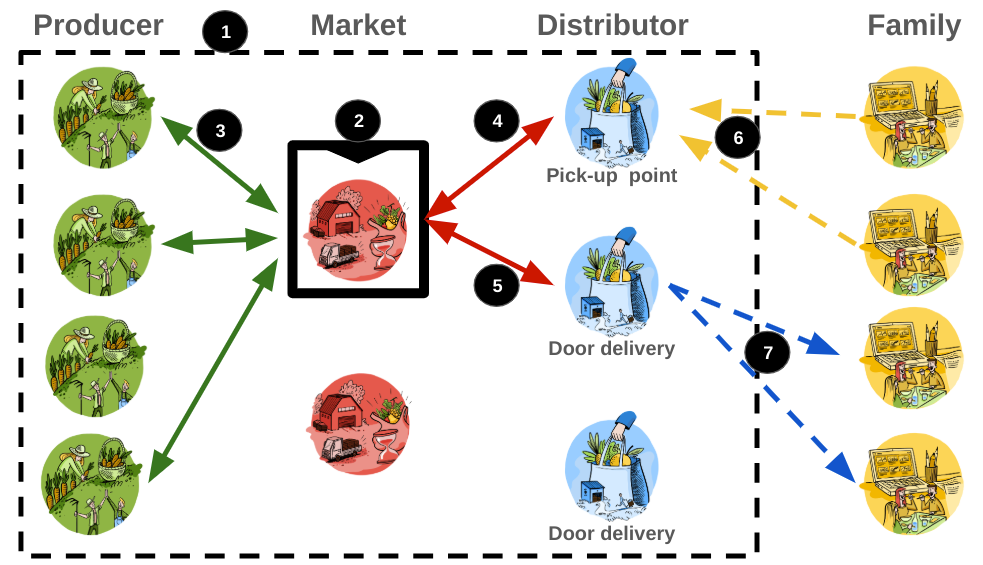
Within the different active roles populating the Loonity platform (1) every single market (2) can create an aggregated offer connecting with different producers (3) and organizing delivery options connecting with distributors. These can be pick-up points (4) where families need to collect the delivery (6) or transport service providers (5) that guarantee door deliveries (7) in a specific area defined by ZIP codes.
2. Collecting orders from the families
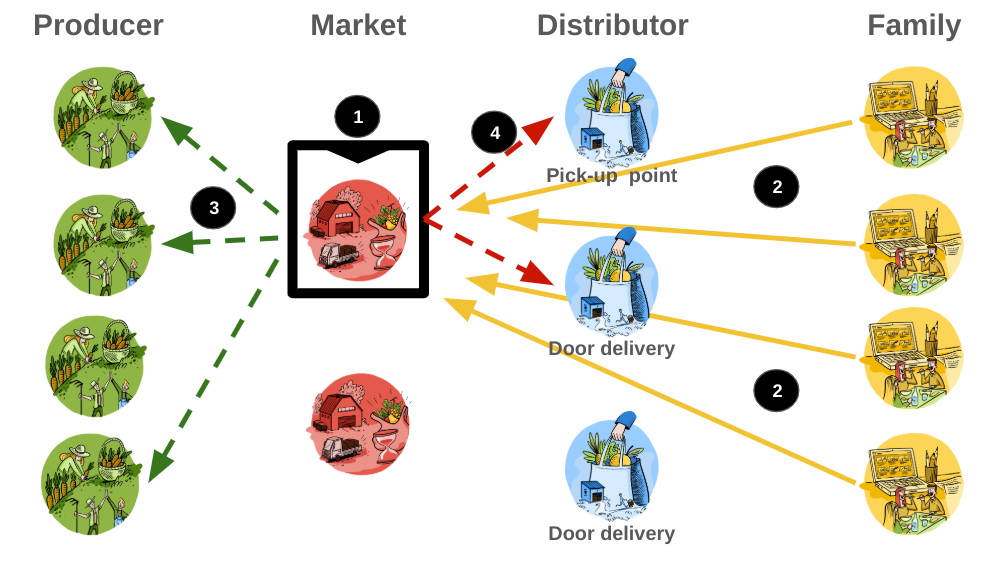
The product’s offer created thanks to the central organization of the market (1) is accessible through the its Loonity’s shop and families can place their orders (2) buying in one shot 3 things: products from the producers (3), coordination and logistics from the market (1) and final delivery service from the distributor (4). Loonity informs in real time everyone about the incoming orders to allow the best possible organization avoiding loss of time.
3. Planning of the delivery process
To create a convenient offer of products to the families the market is in charge of defining a daily, weekly or monthly time planning, denominated logistic model, that can be repeated once or more times per period.
For the distribution of the products a market can have different logistic models to organize the deliveries:
- The market gets all the products from the different producers physically delivered, sorts them according to the orders of the families and hands them over to the distributors for pick-up or final delivery;
- The market coordinates the offer and sets the timing, but the producers deliver directly to the final customers or to the distributor;
- The market agrees different logistic models with the producers, some are coordinated into a common logistics, some deliver on their own.
This Loonity integrated process follows the principle of a “demanding pull-market” in opposition to the “offering push-market” we are all used to. This means that the orders of the consumers “pull” from the producers only what is needed avoiding product waste and allowing absolute freshness. On the other hand consumers have to get used to products that they did not have the chance to choose individually from a basket of possibilities (who buys online is already used to it). Are consumers aware that their habit to pick-up their choice from a shelf causes food waste in supermarkets that can reach 25-30% of the assortment? Let’s help them get conscious about consequences of their behaviors 😉
The logistic model for producers delivering to a centralized market logistics follows this scheme:
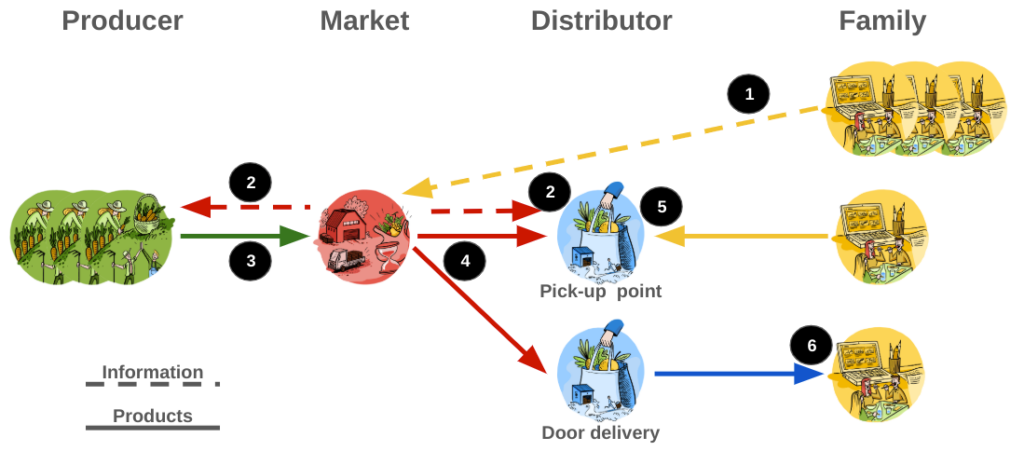
- Order closure time(1): latest time for families to confirm an order for the planned delivery time;
- Producers order time (2): the market can define a time to review the orders before forwarding them to producers and distributors or let it happen simultaneously;
- Delivery time for producers (3): this is the agreed time for the producers to deliver their products to the market;
- Delivery time to the distributors (4): after having composed the family’s orders from the deliveries of the producers these are delivered to the distributors;
- Pick-up (5) or door delivery time (6) for the families: this is the relevant time for the customer, it indicates when he can earliest collect at a pick-up point or latest expect a door delivery.
The logistic model when the producers deliver directly to the customers follows this scheme:
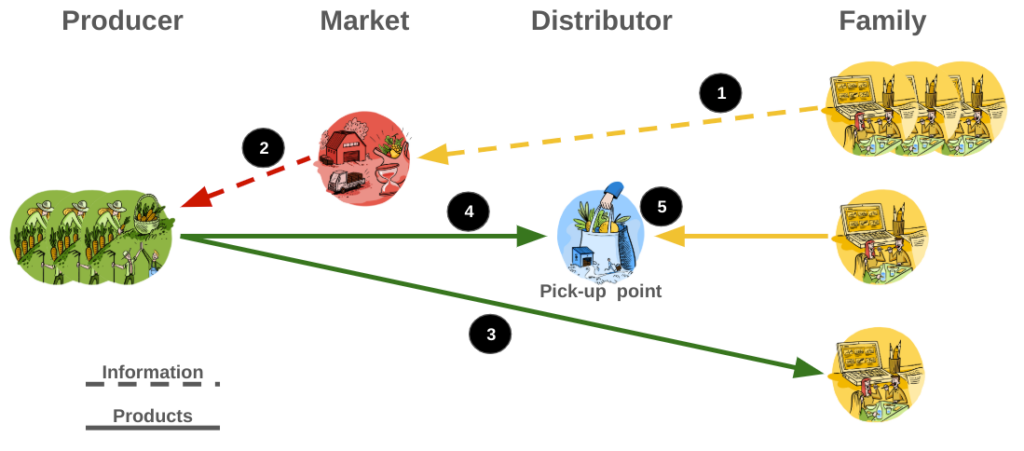
- Order closure time(1): latest time for families to confirm an order for the planned delivery time;
- Producers order time (2): the market normally sends simultaneously the orders to producers;
- Final delivery time: the producers deliver directly to the family’s address (3) or to a distributor (4) where the customer can pick-up (5) his order.
In case the market is connected with producers with different logistic models, the ordered products might have different delivery times. This information will be calculated and provided to the ordering customer opening the check-out process in the Loonity shop.
4. Product delivery from the producer to the final customer
When connecting to each other in Loonity the producers, the market and the distributors are taking agreements about the organization of the deliveries in terms of place, time and modality of packaging of the family’s orders.
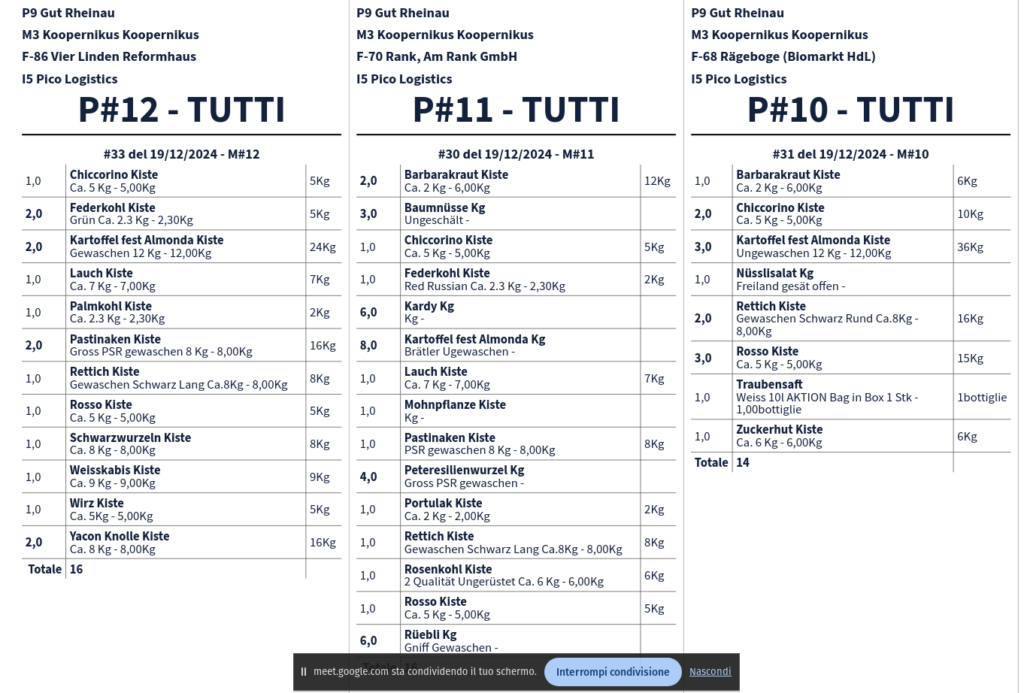
Loonity will provide via email to every user cooperating as producer, market or distributor with the necessary instructions to follow the plan. Clear order lists, packaging information and labels contribute to an optimal logistic flow and thereafter to a perfect service for the customers.
The labels are provided with a QR-code that can be read with a scanner connected to Loonity to speed up logistic processes in case of important volumes.
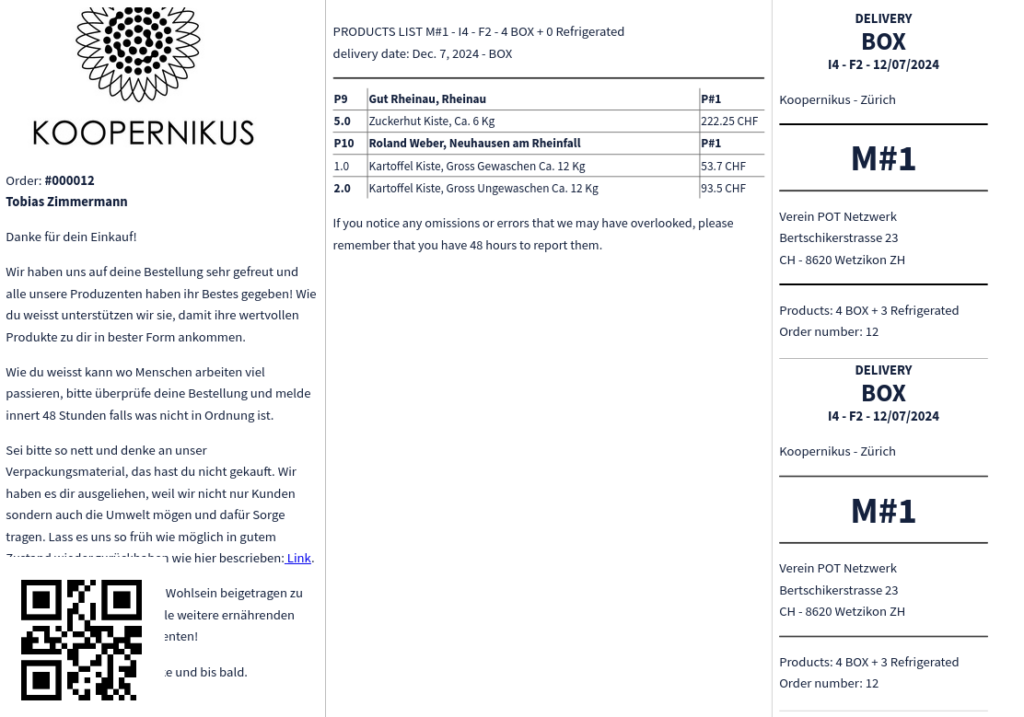
Nevertheless where people work something can always go wrong. In this cases Loonity supports trekking of the events and communication with the involved parties to allow an accurate later invoicing. During the logistic process this information is managed by the active roles under supervision of the market. The market is finally responsible to find a solution to every accident or event and register it in Loonity to share information and adapt invoices accordingly.
After the delivery of the products also families have a determined period of time to announce a product missing or a delivery mistake in Loonity. This will put invoicing on hold and inform the market about the need of its intervention to define a solving agreement.
5. Pricing of the products and invoicing of the orders
The prices of the products in Loonity are created through the agreement between the market and its producers. The money amount requested by the producers for their products added to the request of the market for its services results in the price shown in the market shop. The cost for the distributor’s service can be already included or be shown as additional charge during the check-out process. In most cases the delivery on a pick-up distributor will be included in the displayed shop-price, while a door delivery service is related to an additional cost that will be applied only during the check-out process.
Loonity is not managing directly payment flows, but it is able to generate and send automatically invoices in name of the issuer to the families, the final customers. Also in this case a market can have different configurations in Loonity to be supported with invoicing, this depends on the invoicing model:
- The market buys product from the producers and pick-up or delivery services from the distributors and sells the combination of them to the families;
- The producers buy from the market and distributors their services and invoice an all including final price to the families.
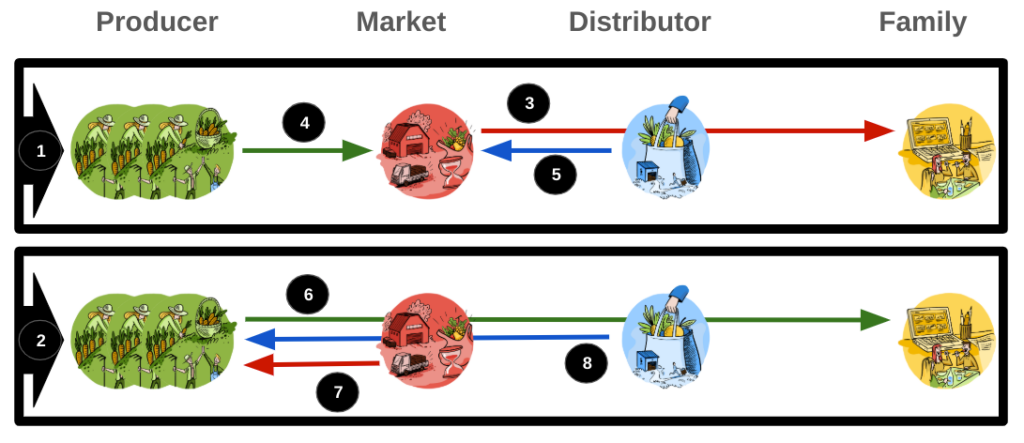
If the market is configured according to the first invoicing model (1) the family will receive an invoice for its orders from the market (3), while the producers (4) and the distributors (5) will invoice their services to the market.
If the market is configured according to the second invoicing model (2) the final customer will receive an invoice for its orders from the producers (6), while the market (7) and the distributor (8) will invoice their services to the producer.
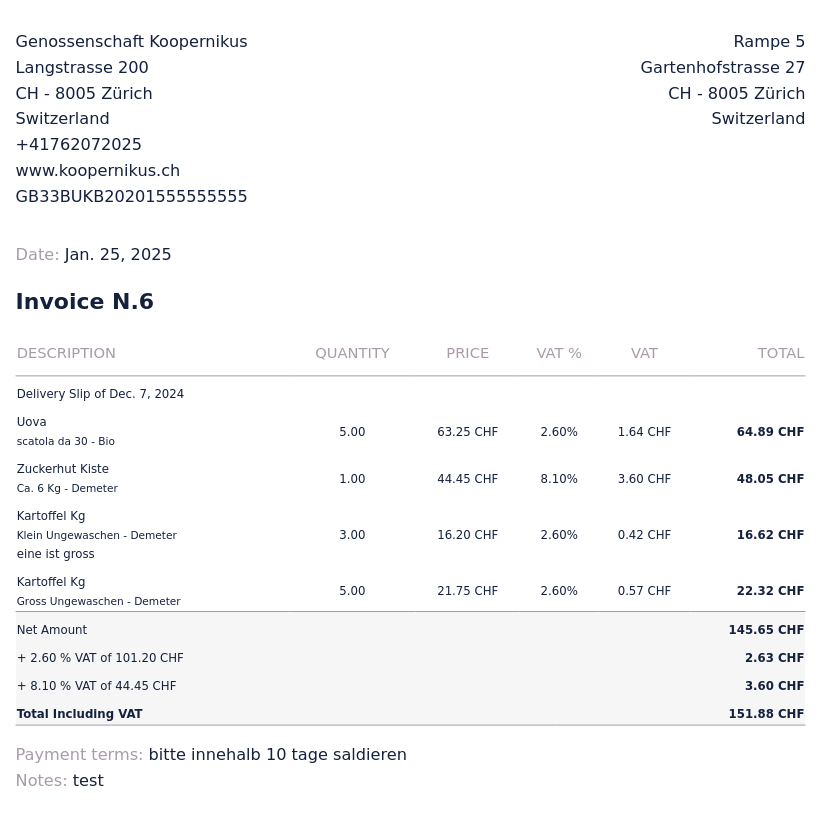
The entire invoicing activity between all parties involved into the production and delivery processes can be completely automated through Loonity. The ordered products and eventual rebates or credit notes due to delivery problems will be detailed and sent via email to the receiver. The billing documents will be provided with VAT when present and are therefore suitable also for B2B a purpose.
The automatic invoicing can be scheduled in Loonity from every producer, market and distributor independently with this options:
- prepare invoices at the end of a period of time;
- prepare invoices when a certain amount has been reached;
- prepare an invoice for every single order.

 English
  Deutsch (Schweiz)