
A distribution network is the sum of activities of a lot of people that cooperate and interact delivering products or services and exchanging information with the others, in particular with the final customers . To create a functional information flow between all this actors and enable them of an efficient organization Loonity’s architecture divides the activities on 4 different roles. These are described in general on the public website and can be found here: https://www.loonity.com/en/functions/.
Before entering into the matter and talking about the 4 roles that users can assume on Loonity, allow us to make a short introduction of the color codes that were used to characterize them. As you already might have noticed on the public website we use “green, blue, red and yellow”. This color combination is used, even if some other combination variants sometimes occur, in the alchemy tradition to describe the basic elements of the universe “earth, water, fire and air”. So we did not copy them from Google (that uses them without explaining why) but choose them to represent the four different roles and their activities we have foreseen in Loonity’s organization model of local distribution networks:
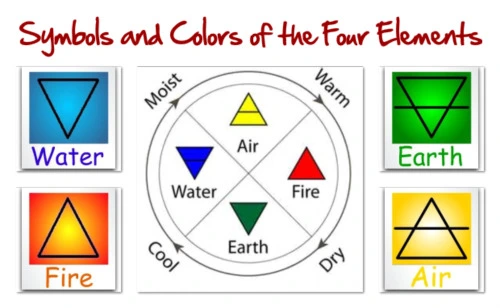
Earth is green: this is the basic element of our material subsistence, it represents the animal needs and the physical body. There is no doubt this fits perfectly for the producers.
Fire is red: action, game, human’s relationships and warmth are represented by this element. It is a changing and transforming force, the one everyone expects from the markets to develop and promote local product distribution.
Water is blue: empathy, flexibility, adaptation to every form of environment, unstoppable on its way. This is just the perfect element to describe optimal final distributors.
Air is yellow: this element is everywhere, it can come and disappear at the speed of a breath of wind and it is so deeply important to survive and flourish, exactly like customers are.
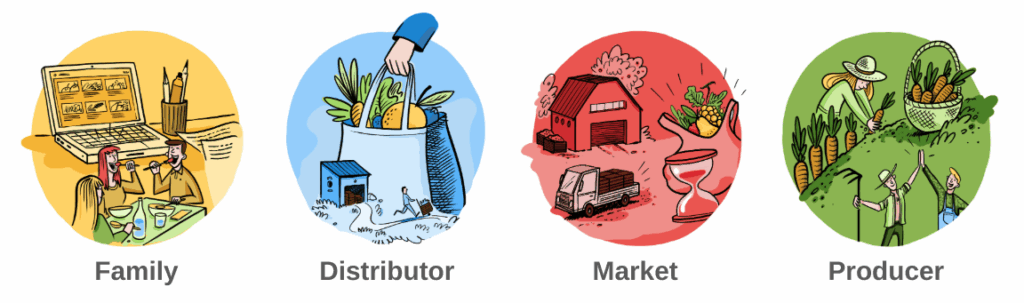
After this short alchemy excursion let’s go back to some functions and explain how a user can upgrade his family profile to an active role. Well, it might need an explanation! Loonity has 4 roles, one is passive and 3 are active. The only task a family can absolve is to buy from the markets, manage its carts and look into past orders and received invoices. All this functions are displayed on the left hand menu bar under the menu category BUY (1). Even if this is a very important and welcome action, we describe it in Loontiy as passive, because it’s the funny part that does not need any professional engagement 😉
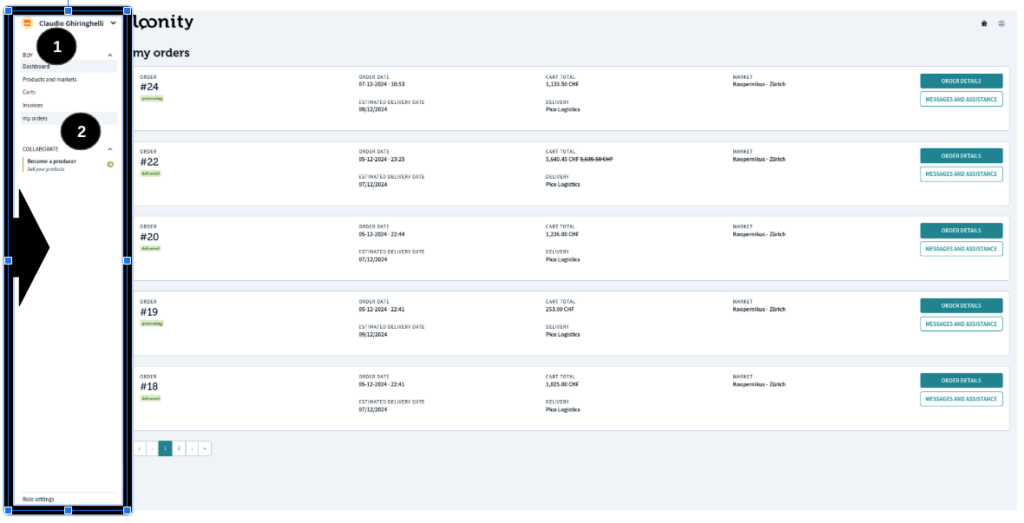
The 3 active roles can be activated through the button Become a producer (2), Become a market and Become a distributor. This three buttons are subordinated to the menu category COLLABORATE. So, we tried to make it easy: under BUY you find all functions related to being a customer, under COLLABORATE all functions to interact selling products or services as a producer, market or distributor. Becoming an active role leaves completely intact the functions of the family, they just get more and never less.
This are short descriptions of the functions of the different roles, more details will be provided in the specific role description chapters:
- the role producer enables to manage an own presentation profile, keep descriptions and images of the own products updated, define changes in availability, manage holidays closures, get orders from clients and receive clear instructions about how and when to deliver, manage delivery problems and generate automatically invoices to the customers;
- the role market allows to connect producers registering the agreement on operational issues with them on Loonity, generates a shop interface, defines a time schedule and the logistic hubs, manages and supervisors operations and takes care of customer support: invoicing is also completely supported;
- the distributor offers delivery service in 2 different ways. It can serve as pick-up point for families or as door delivery service provider in a given area defined by ZIP codes. It gets precise delivery instructions and notes over email like all other active roles, following the operational planning agreed with the market.
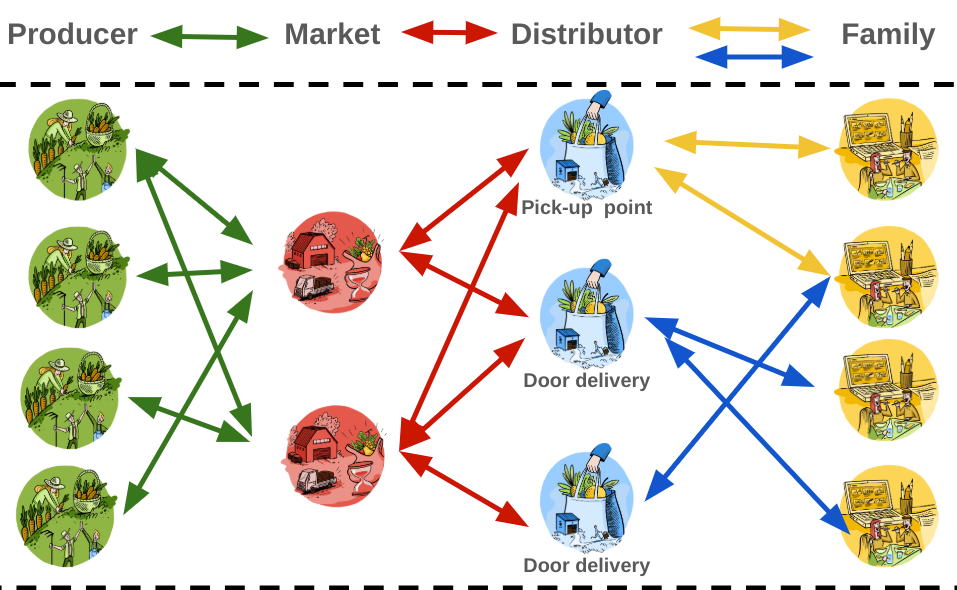
The role’s connection always follows the scheme producer-market-distributor-family. To be able to sell products a market shop needs products through at least one producer and distribution options through at least one distributor.
Lets now clarify some important aspects about the roles capabilities:
- a family can activate at the same time one, two or all three active roles. When it wants to operate as a market normally all active role’s functions are available. When all roles are active a market can also be used as Loonity shop for a single producer with the only option of pick-up point at the producer itself. In this case Loonity equals an ordering platform for customers that uses the Loonity functions at the lowest possible level of its capabilities;
- a producer can connect simultaneously to more markets, being able to cooperate from his Loonity producer’s profile interface with all of them;
- a market can enlarge his network of producers and distributors as much as he wants, scaling the assortment to its needs and offering different distribution options to its customers;
- a distributor can offer its services to more markets at the same time, functioning as pick-up point or door delivery services in the same way for all of them.
There is a lot of different variables in this collaboration model, this makes Loonity flexible and opens a lot of possibilities to start and to improve organization in time without efforts and investements. We will go in deeper details in the specific active roles description articles in this documentation.

 English
  Deutsch (Schweiz)
  Italiano